Key Takeaways
Buying Cheap Mini Cooper S parts Sunshine Coast – cash & carry can work well when you confirm fitment, inspect condition, and understand the seller’s terms before handing over money.
- Match every part to the Mini’s generation, year, body style, engine, and transmission.
- Use the VIN and OEM number together rather than relying on appearance alone.
- Compare local recycled parts with rebuilt and aftermarket options for the repair at hand.
- Inspect mechanical, body, and electrical parts before paying, especially when sold as-is.
- Plan transport, installation, documentation, and future maintenance before collecting bulky parts.
Find the right Mini Cooper S parts for your model
Mini Cooper S parts can look very similar across several years while differing in connectors, mounting points, software, or internal specification. A cheaper component is not a bargain if it needs modification or cannot be returned. Start with the vehicle details, then narrow the search to the exact component and its condition. That simple order prevents many expensive mistakes.
Match parts by generation, year, and body style
Begin by identifying the Mini’s generation and production year, then record whether it is a hatchback, convertible, Clubman, or Countryman. Body style affects doors, glass, bumpers, lighting, trim, and some suspension parts, even when the model badge appears familiar. Facelifts can also bring different grilles, lamps, wiring, and interior fittings. Photograph the original part and its mounting points before visiting a yard so you have a practical comparison.
The registration details may help a seller begin the search, but they are not always enough for precise fitment. Note the engine size, transmission type, drive layout, and any factory options that affect the component. A matching visual shape is useful evidence, not final proof.
Use VIN and OEM numbers to confirm fitment
The VIN gives the seller a reliable starting point, while the OEM number usually narrows the search to a particular component family. Check the number stamped or printed on the old part where possible, and compare superseded numbers rather than assuming that every replacement number is interchangeable. Some parts share a housing but use different internals or calibration.
Ask for a clear photograph of the donor part’s label, connector, and mounting face before making a trip. This is especially helpful for sensors, control units, alternators, and air-conditioning components. Confirm fitment in writing when buying remotely, and keep the message with your receipt in case the seller’s return policy depends on the part being incorrectly supplied.
Identify differences between Cooper S engine variants
Cooper S engines have changed over time, and two cars with similar badges may use different engine families, turbo arrangements, sensors, cooling systems, or accessory brackets. The engine code, build date, and transmission pairing are more useful than the badge by itself. A complete engine assembly may also be sold without ancillaries, wiring, ECU, turbocharger, or intake equipment, so ask exactly what is included.
For an engine-related purchase, request compression or running information when available and ask why the donor vehicle was dismantled. Compare oil condition, coolant contamination, visible leaks, and the condition of the turbo and drive belt system. If the seller cannot test the assembly, price it as untested rather than treating it as a verified replacement.
Know which parts are interchangeable across Mini models
Some service items, fasteners, switches, wheels, and trim pieces may cross between Mini models, but interchangeability is never guaranteed by the brand name alone. Compare the OEM number, dimensions, connector shape, handedness, and software requirements. A Countryman component may fit the physical space yet have different suspension loading or electronic programming from a hatchback part.
Ask the recycler to confirm the donor model and whether the part was removed from a running vehicle. For electronic modules, the need for coding or initialization can matter as much as the physical fit. When in doubt, buying a verified matching part is usually cheaper than paying twice for removal and refitting.
Compare local sources for affordable parts
Local wreckers and auto recyclers can be useful when you need a part quickly, want to inspect it yourself, or hope to avoid shipping charges. Online listings make price comparison easier, but photographs may hide corrosion, missing brackets, or incompatible connectors. A sensible search uses both approaches without assuming the lowest listed price is the lowest total cost.
Sunshine Coast buyers should also consider collection time, loading access, and whether the seller serves the public or mainly trade customers. Call before driving over, especially for a less common Cooper S component. A short conversation can establish whether the part is in stock, tested, complete, and held under your name.

What to expect from Mini wreckers and auto recyclers
A recycler normally identifies a suitable donor vehicle, removes the requested component, and assesses its visible condition before offering it for sale. Stock can range from engines, transmissions, and suspension assemblies to doors, lights, seats, dashboards, and small brackets. Some sellers test parts; others clearly label them untested or sell them for parts only.
Ask how the component was checked, whether its mileage is known, and whether the price includes attached hardware. A used part may be perfectly serviceable while still showing normal cosmetic wear. The useful distinction is whether its condition matches the repair you are planning, not whether it looks new.
When used genuine parts offer the best value
A used genuine part can make sense when the original design is complex, the replacement is expensive, or a new aftermarket version has uncertain fit. Body panels, interior trim, glass, wheels, brackets, and some suspension housings are often easier to match when sourced from a comparable donor. You may also retain the factory finish or connector arrangement.
Used is less attractive when labor to install the part is high and the component has an unknown service life. A low-priced starter motor or sensor may still require testing before installation. Compare the part price with the cost of access, fluids, seals, coding, and a second repair if it fails soon after fitting.
Comparing local cash-and-carry yards with online sellers
Local collection gives you a chance to examine the part and resolve questions face to face. An online seller may offer a larger catalog, but shipping, handling, and return freight can change the calculation. Ask whether the image shows the actual part or a stock photograph, and check the stated location before assuming collection is possible.
The following comparison is a useful starting point when deciding where to buy:
| Buying factor | Local cash-and-carry yard | Online listing | Best question to ask |
|---|---|---|---|
| Inspection | Usually possible before payment | Often limited to photographs | Can I inspect the actual part? |
| Speed | Same-day collection may be available | Depends on dispatch and freight | When can I have it installed? |
| Transport | Buyer often arranges collection | Shipping is arranged by seller | What is the total delivered cost? |
| Returns | Terms vary by yard | Terms should be stated in listing | What happens if fitment is wrong? |
Use the answer to each question rather than the headline price alone. For a fragile lamp or bulky panel, local inspection and collection may outweigh a small online saving; for a compact, well-identified sensor, delivery may be more convenient.
Finding discontinued or hard-to-source components
For older or lower-volume Mini variants, search by OEM number and donor model instead of using only the common part name. A seller may list a component under a different description, especially if it was removed as part of a larger assembly. Clear photographs of mounting points and connectors can help you identify a match when the listing wording is vague.
Contact several local sources with the same information and ask whether they can notify you when a donor arrives. If the part is scarce, resist buying an incomplete assembly without first pricing the missing pieces. A rare item is not useful if the final cost exceeds a complete alternative.
Inspect used parts before you pay
Inspection is where a low-cost purchase either becomes sensible or falls apart. Bring the old part, photographs, a tape measure, and a flashlight when practical. Look beyond surface cleanliness: check wear, missing hardware, water damage, and signs that the component has already been repaired. If you cannot test it, make sure the price and return conditions reflect that uncertainty.
Check wear on engines, transmissions, and driveline parts
For engines and transmissions, inspect mating surfaces, mounting points, seals, plugs, wiring, and signs of impact. Look for excessive oil residue, damaged threads, cracked housings, and corrosion around coolant passages. On a transmission or differential, ask whether it was drained and whether metal debris was found in the fluid.
Axles and other driveline parts deserve attention at the boots, joints, splines, and flanges. A torn boot or stiff joint may turn a cheap assembly into an immediate rebuild. Ask about donor mileage and listen for any available running noise, but do not treat a visual check as a mechanical test.
Look for damage on body panels, lights, and trim
Place body panels on a flat surface if possible and check the edges, seams, mounting tabs, and inner structure. Small dents can be repaired, but stretched metal, rust-through, missing brackets, or a distorted hinge area may cost more than the panel saves. Confirm the body color and whether the panel is from the same body style and facelift.
For headlights and taillights, examine the lens for cracks, moisture, clouding, and broken tabs. Interior trim should be checked for warped plastic, damaged clips, torn upholstery, and missing fasteners. Cosmetic wear is often manageable when disclosed, while hidden structural damage is a stronger reason to walk away.
Test electrical components and electronic modules
Electrical parts should be identified by exact number and connector configuration before testing. Check pins for bending or corrosion, inspect the casing for water entry, and ask whether the component was tested in the donor vehicle. A module can appear clean and still require programming, pairing, or a reset before the car will accept it.
Where a test bench or donor vehicle is available, ask what function was verified rather than accepting a general statement that the item works. For motors, switches, alternators, and window regulators, a basic operational test is useful. Keep in mind that testing may not reproduce every fault under load or after the part becomes hot.
Confirm return conditions for untested or sold-as-is parts
Before paying, ask whether the part is tested, guaranteed, exchangeable, or sold as-is. Clarify the time limit, whether the original markings must remain intact, and who pays return freight. Some parts cannot be returned after installation, modification, or attempted repair, so the policy should be understood before work begins.
A low price only has value when the risk attached to it is clear.
Write the agreement on the invoice or receipt when possible, including the part number and any promised test result. If the seller offers an exchange rather than a refund, check that the replacement period gives you enough time to install and verify the component.
Choose between used, rebuilt, and aftermarket components
The right source depends on the part’s failure risk, installation cost, and effect on safety. Used genuine parts can be excellent for some simple or cosmetic repairs, while a rebuilt unit may offer more predictable wear life. Aftermarket parts range from well-made alternatives to poorly controlled copies, so the label alone does not settle the question.
Set a budget that includes installation materials and likely follow-up work. A new seal, filter, fluid, gasket, or mounting bolt may be sensible even when the main assembly is used. This approach keeps the repair affordable without pretending every component has the same risk profile.
Which parts are usually safe to buy used
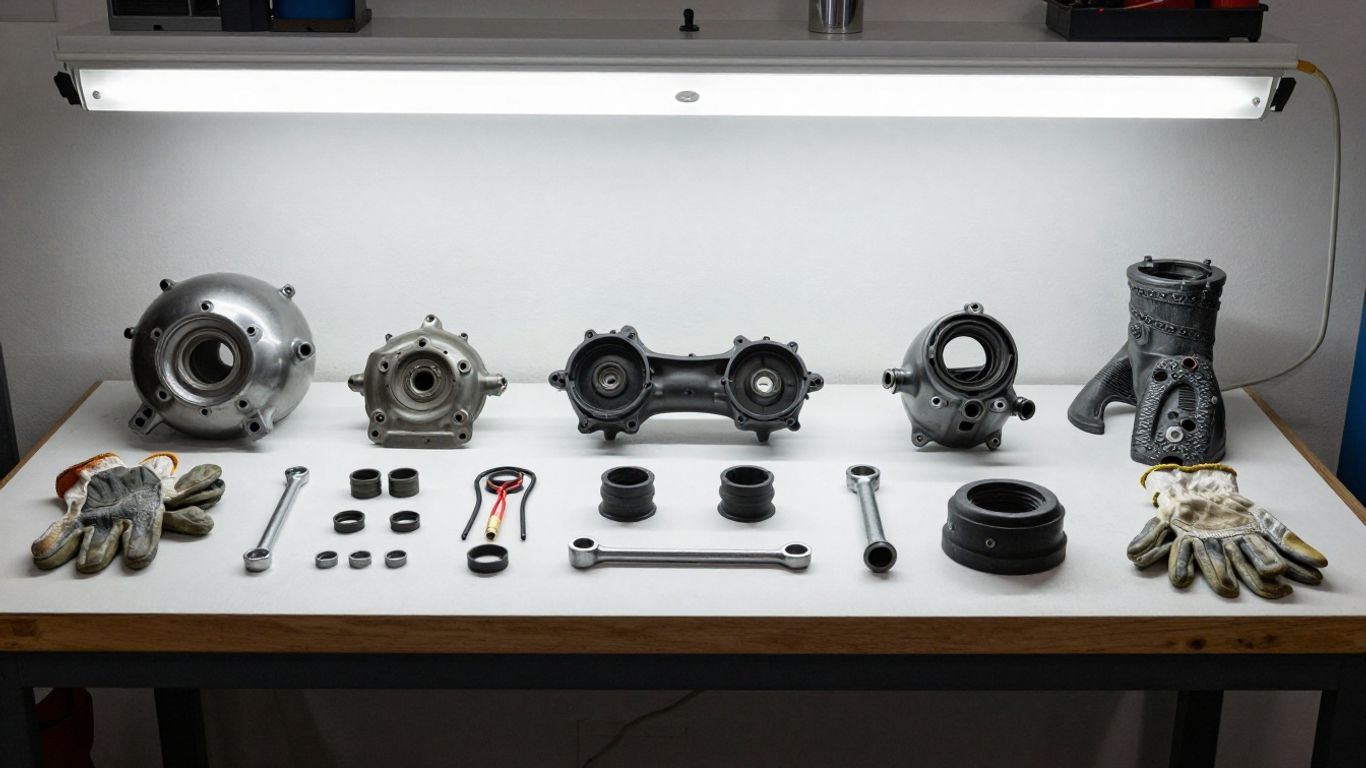
Used body panels, interior pieces, wheels, brackets, mirrors, glass, and uncomplicated housings are often reasonable choices when they are undamaged and correctly matched. Some non-wear electrical accessories can also be worthwhile if their number is correct and their operation has been checked. Condition still matters, particularly for items exposed to water, heat, or road impact.
Wear-sensitive parts need a more careful calculation. A used radiator, clutch, damper, belt tensioner, or wheel bearing may have limited life left even if it looks acceptable. Ask what failed on the donor car and whether the part was removed because it was known to be defective.
When rebuilt mechanical parts are a better choice
Rebuilt components can be preferable when the part contains bearings, seals, friction surfaces, or other internal wear items that are difficult to evaluate from outside. A reputable rebuild should come with a clear scope of work, replacement parts used, and warranty terms. The word “rebuilt” by itself does not explain how thoroughly the unit was remanufactured.
Compare the warranty length and exclusions with the labor involved in replacement. A rebuilt transmission or steering component may cost more initially but provide a clearer expectation than an untested used assembly. Ask whether the unit requires break-in, calibration, fluid specification, or special installation steps.
Where aftermarket parts can reduce repair costs
Aftermarket components can lower the purchase price for routine service items, seals, filters, hoses, brake hardware, and other parts where a suitable specification is available. Check the manufacturer, material, dimensions, certification where relevant, and warranty rather than choosing solely by price. The part should meet the vehicle’s required specification and suit the way the car is used.
For safety-critical or electronically controlled parts, verify compatibility particularly carefully. A component that fits physically but sends the wrong signal or has an unsuitable friction material can create additional faults. Ask a technician or parts specialist when the catalog information is unclear.
Avoiding low-quality components that create repeat repairs
Warning signs include vague listings, missing part numbers, stock images for supposedly used items, unexplained price differences, and sellers who cannot describe testing. Be cautious of components with rough castings, poor seals, damaged connectors, inconsistent labeling, or no meaningful warranty. A bargain that fails after installation can cost more in labor than the original part.
Prioritize traceability: record the seller, donor vehicle, part number, date, and warranty. Buy the best-supported option that fits the repair’s risk. Sometimes that is used; sometimes rebuilt or aftermarket is the more economical decision over the life of the vehicle.
Get the best cash-and-carry price
Cash-and-carry buying works best when you arrive prepared rather than trying to identify the car from memory. Have the vehicle details, part number, photographs, and a realistic budget ready. You will then be able to compare the offer with alternatives without making a rushed decision. A friendly, specific conversation is usually more productive than simply asking for the lowest possible price.
Prepare the part number and vehicle details before visiting
Write down the VIN, model, build year, body style, engine code, transmission, and the exact part you need. Bring the old component or clear photos of its label and connectors. If the part is large, measure the available space in your vehicle and bring straps, blankets, and protective wrap.
Call ahead with the number and ask the seller to confirm stock, condition, price, and collection timing. Request that the part be held only if the seller’s policy allows it. Preparation reduces the chance of buying a similar-looking component that cannot be fitted.
Compare prices using local and online listings
Collect several comparable prices, making sure each listing describes the same condition and included hardware. Separate tested, warrantied parts from untested units, and add freight, taxes, core charges, and return costs where applicable. A local quote may be higher at first glance but cheaper once delivery and delay are included.
Use a simple written comparison while you call around. Record the part number, donor details, test status, warranty, collection time, and total cost. That makes differences visible and gives you a calm basis for choosing rather than haggling blindly.
Negotiate fairly when buying multiple Mini parts
A seller may be more open to a package price when several parts come from one donor or can be collected together. Ask for a combined quote and identify which items are most urgent. Keep the request reasonable: a clean, tested component with a return period should not be compared with an untested part sold as-is.
Agree on the exact contents of the package before payment. List separate part numbers and prices on the invoice, even if the total is discounted. This protects both sides if one item turns out to be incorrect or missing hardware.
Factor in deposits, warranties, and pickup costs
The advertised part price may not be the final amount. Ask about refundable deposits, exchange requirements, loading fees, delivery, packaging, and warranty exclusions. For an exchange unit, confirm whether the old component must be returned and whether the deposit is refunded after inspection.
A short warranty can be valuable when installation is straightforward, but it may not cover labor, fluids, diagnosis, or consequential damage. Get the terms before paying and keep every receipt. Those details matter if the part needs to be exchanged later.
Plan pickup, installation, and ongoing maintenance
A successful purchase ends with a part that arrives safely, is installed correctly, and can be traced if a problem appears. Plan the collection before you commit, particularly for engines, transmissions, doors, glass, and large body panels. Also consider whether the repair requires coding, specialist tools, fluid changes, or a post-installation inspection. Saving on the part should not mean improvising the rest of the job.
Transporting bulky or fragile parts from the Sunshine Coast
Use a suitable vehicle, strong straps, padding, and a dry cover for bulky components. Keep glass upright and supported, protect painted panels from abrasion, and avoid placing heavy items on wiring or trim. Engines and transmissions need stable support and should not be allowed to roll during transport.
Confirm loading arrangements with the yard before arriving. If you are collecting in wet weather, bring plastic sheeting and absorbent material, but do not seal damp electrical parts in a way that traps moisture. Photograph the part and packaging at collection if its condition is disputed later.
Tools and preparation for self-installation
Read the relevant repair instructions and gather sockets, torque tools, jacks, stands, labels, containers, and replacement consumables before removing the old part. Photograph wiring and hose routing as you go, and label connectors that could be confused. Make sure the vehicle is securely supported; a jack alone is not a safe working platform.
Allow extra time for seized fasteners, damaged clips, fluid disposal, and cleaning mating surfaces. Compare the replacement with the old part before installation so differences are found while the vehicle is still intact. If a procedure calls for calibration or a diagnostic reset, arrange the equipment in advance.
Parts that should be fitted by a qualified technician
Professional help is prudent for braking and steering systems, airbags, structural components, high-voltage equipment, major driveline work, and repairs requiring programming or specialized calibration. Engine and transmission replacement may also involve alignment, coding, fluid procedures, and testing that are difficult to complete safely without suitable equipment.
A technician can inspect the surrounding system and identify why the original part failed. That matters when replacing a turbocharger, cooling component, electrical module, or suspension assembly. Ask for an itemized estimate that separates labor, consumables, diagnosis, and any required programming.
Keeping records for future repairs and resale value
Keep the invoice, OEM number, donor details, mileage if known, warranty terms, photographs, and installation date in one vehicle file. Record any new fluids, seals, filters, bolts, or programming completed at the same time. These notes make future diagnosis easier and help establish what has been replaced.
Good records also give a future buyer a clearer maintenance history. If a used part was installed with a limited warranty, note the expiry date and any conditions. A modest amount of paperwork can prevent repeated searching and support a more honest resale conversation.
Conclusion
Affordable Mini Cooper S ownership is easier when the purchase is treated as a complete repair decision rather than a hunt for the lowest sticker price. Match the part carefully, inspect it honestly, compare total costs, and plan installation and returns before collection. With those habits, local cash-and-carry sourcing can reduce repair expense without turning uncertainty into another breakdown.